The Final Withholding Tax (FWT) is an essential feature of the Philippine income tax framework under the National Internal Revenue Code of 1997 (NIRC) in Sections 57, 58, and 59, as amended and its implementing regulations are found in Revenue Regulations (RR) No. 11-2018, and RR 02-2020. It functions as a tax collection system at the source, where the amount withheld by the payor from specified income payments constitutes the full and definitive tax obligation of the income earner with respect to that particular income. Consequently, the recipient is no longer required to report the income in their gross income for annual income tax purposes, nor may they claim any tax credit or refund for the amount withheld.
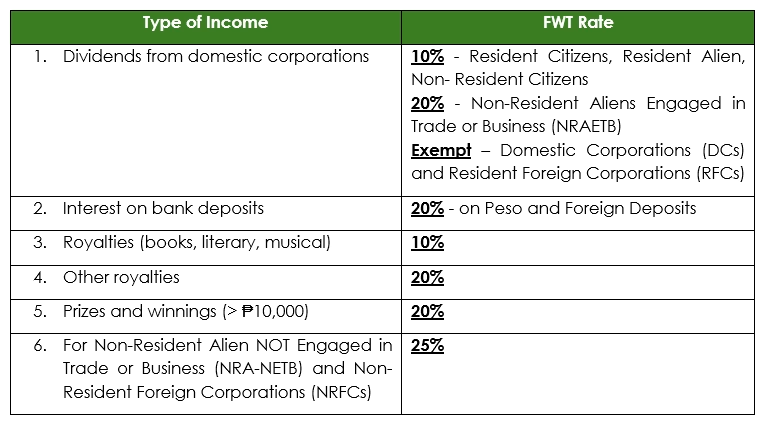
FWT is imposed upon withholding agents to facilitate direct and efficient collection as this reduces the need for the recipient to file a separate tax return for passive income earned. Also, it minimizes the risk of taxpayers failing to report their income or underreporting it, as the withholding agent is responsible for the proper remittance of taxes to the government. This typically applies to certain types of passive income, including interest income, royalties, dividends, prizes, and other winnings, where taxation is completed upon withholding.
The Framework: Who Withholds? What are the Rates? and When to File?
A. Who Withholds? (Withholding Agents)
Any person—whether natural or juridical—including government agencies, instrumentalities, government-owned or controlled corporations (GOCCs), and international organizations (to the extent allowed by law) that makes payments subject to FWT is legally designated as a withholding agent.3 The duty to withhold the obligation to deduct and withhold the tax arises at the time the income has become payable.
Non-compliance with this obligation exposes the withholding agent to personal liability for the deficiency in withholding, together with the corresponding surcharges, interest, and penalties imposed under applicable tax laws.
B. What are the Rates?
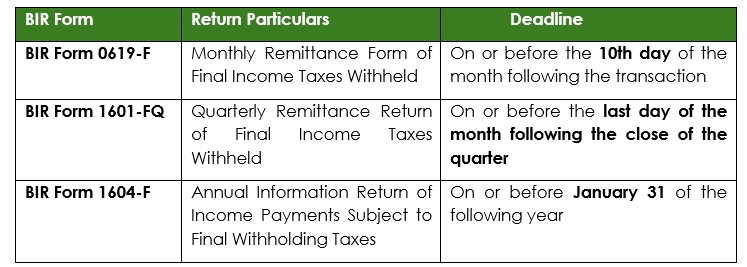
C. When to File?
Timely compliance with the filing and remittance requirements for Final Withholding Tax (FWT) is essential, as the Bureau of Internal Revenue (BIR) imposes strict statutory deadlines for both periodic remittance and annual reporting obligations.
Key Takeaway
Final Withholding Tax (FWT) is more than a mere collection mechanism—it is a compliance safeguard embedded within the Philippine tax system. By shifting the responsibility to withhold and remit the tax at source, the Bureau of Internal Revenue (BIR) ensures efficient revenue collection while minimizing reporting burdens on income recipients. However, this system also places significant responsibility on withholding agents, as errors or omissions may result in personal liability, penalties, and regulatory exposure.
In essence, proper understanding and timely compliance with FWT obligations are not optional administrative tasks but critical components of sound tax governance and risk management.
When tax is withheld at the source, compliance is immediate—but the consequences of neglect can endure.
Found this helpful? ♻️ Share and follow Babylon2K & UHY M.L. Aguirre & Co., CPAs for more.
P.S. Powered by hashtag#BethAI – ai.babylon2k.org, your intelligent assistant for tax, audit, accounting, and licensing.
Article written by: Kyle Clarence L. Williams, CPA, CTT, MICB, RCA, CAT