

With the recent issuance and approval by the President of the Philippines through Memorandum Order No. 47, effective 17 June 2026, the 2026 Strategic Investment Priority Plan (SIPP) introduces additional priority sectors that reflect the government’s continuing efforts to strengthen the country’s competitiveness in an increasingly digital and innovation-driven global economy. By recognizing emerging and high-value industries such as cybersecurity, artificial intelligence, and data center infrastructure, the 2026 SIPP signals a policy shift toward attracting investments that are not only capital-intensive, but also technology-oriented, productivity-enhancing, and capable of generating higher-value employment opportunities.[1]
These additions are expected to support the government’s broader objective of positioning the Philippines as a more future-ready and strategically relevant investment destination. As businesses increasingly rely on digital infrastructure, data security, automation, and advanced technologies, the inclusion of these sectors under the SIPP may encourage both local and foreign investors to consider the Philippines as a viable hub for next-generation industries. In turn, this may help deepen the country’s participation in global value chains, promote knowledge-based activities, and enhance the Philippines’ attractiveness as a location for regional operations, shared services, and technology-driven enterprises.
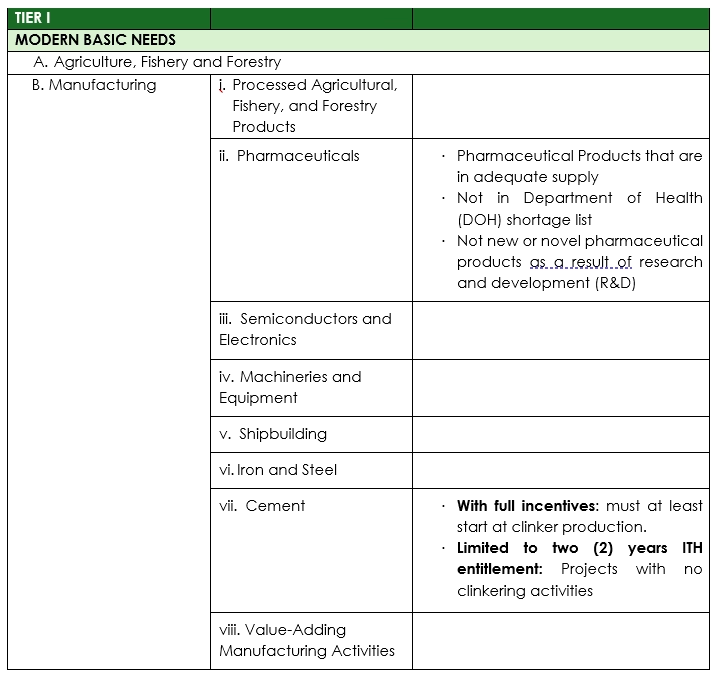
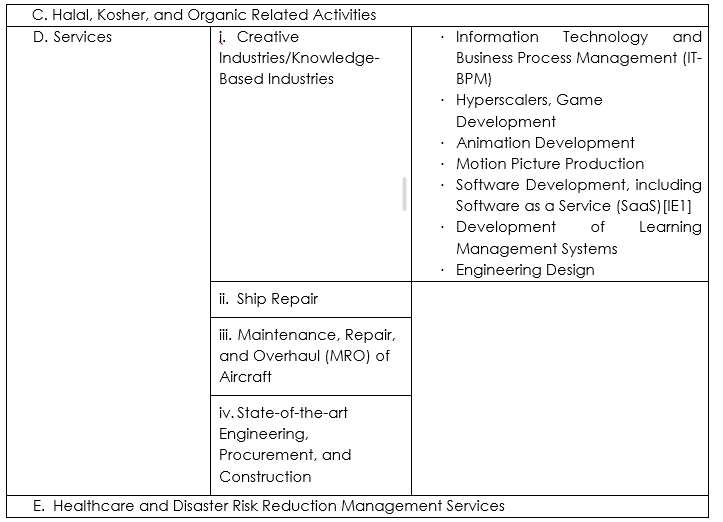
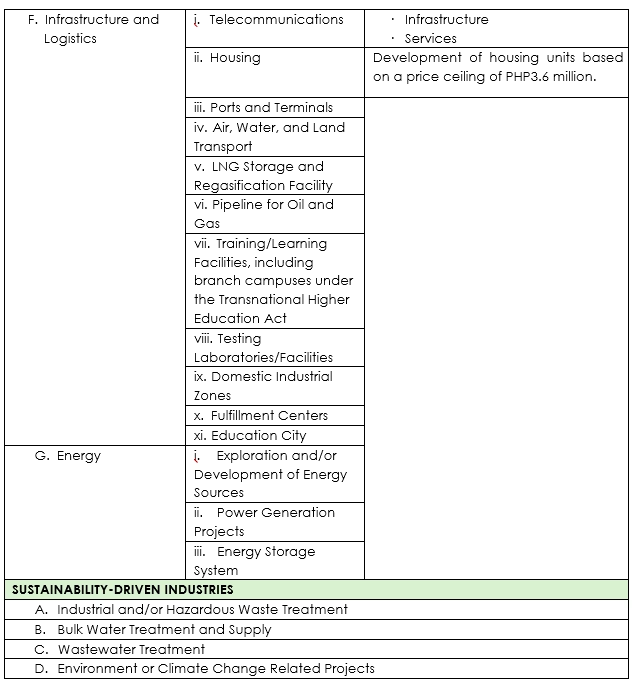
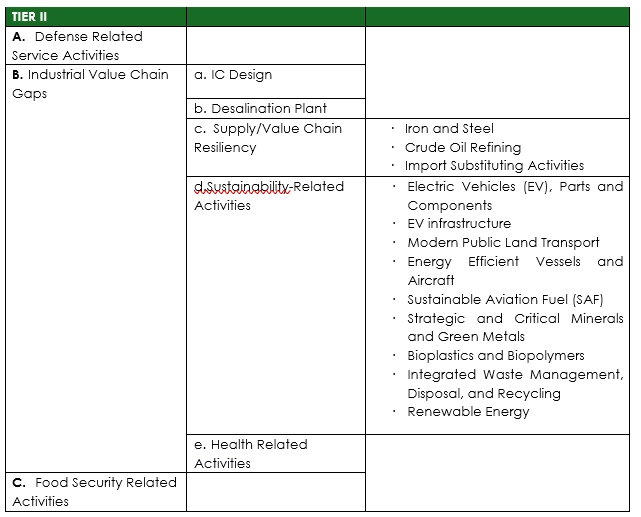
Under the 2026 SIPP
The 2026 SIPP is consistent with the National Government’s broader policy agenda, as reflected in AmBisyon Natin 2040, PAGTANAW 2050, the Trabaho Para sa Bayan Plan, and the Philippine Development Plan 2023 to 2028.
The Memorandum Order also provides that, pursuant to Section 296 of the National Internal Revenue Code (NIRC), as amended, the industry of the registered project or activity shall be prioritized based on the national industrial strategy set out in the SIPP. It further provides that the SIPP shall define the scope of the tiers and prescribe the conditions for activities to qualify.
Under the same section, Tier I shall include activities that:
- have high potential for job creation;
- take place in sectors with market failures resulting in the under-provision of basic goods and services;
- generate value creation through innovation, upgrading or moving up the value chain
- provide essential support for sectors that are critical to industrial development; or
- are emerging owing to potential comparative advantage.
Tier II shall include activities that produce supplies, parts and components, and intermediate services that are not locally produced but are critical to industrial development, as well as import-substituting activities, including crude oil refining.
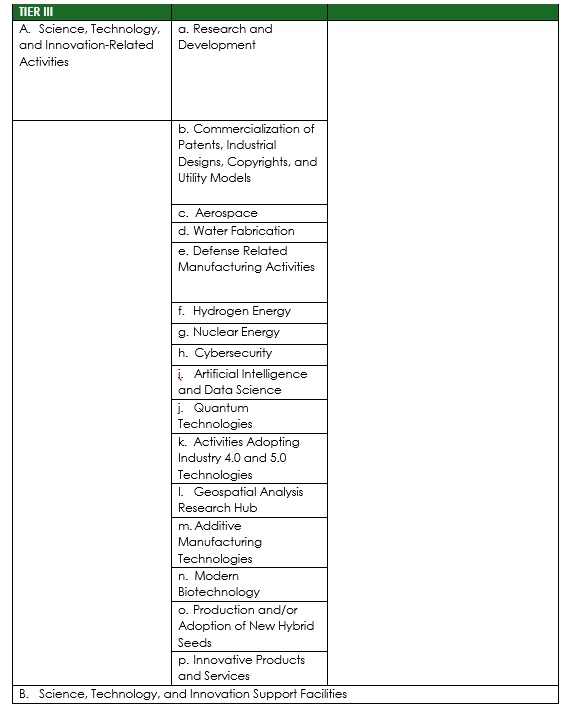
Tier III shall include activities that:
- involve research and development resulting in demonstrably significant value-added, higher productivity, improved efficiency, breakthroughs in science and health, and high-paying jobs;
- generate new knowledge and intellectual property registered and/or licensed in the Philippines;
- involve commercialization of patents, industrial designs, copyrights and utility models owned or co-owned by an RBE;
- involve highly technical manufacturing; or
- are critical to the structural transformation of the economy and require substantial catch-up efforts, including, but not limited to cyber-security, artificial intelligence, and data center facilities.
Key Takeaway
The inclusion of key and critical sectors in the amended SIPP reflects the government’s recognition that fiscal incentives alone may no longer be sufficient to win the next wave of quality investments. While tax incentives remain an important tool, the Philippines’ ability to attract sophisticated, high-value, and technology-driven projects will also depend on how effectively it can build a broader investment ecosystem—one that supports digital infrastructure, develops a future-ready workforce, streamlines regulatory processes, strengthens ease of doing business, and ensures that innovation-led enterprises can scale and operate with confidence.
Ultimately, the success of the 2026 SIPP will be measured not only by the number of projects registered or incentives granted, but by the quality of investments it brings into the country and the long-term value they create for the economy. As the Philippines positions itself to compete for advanced technology, cybersecurity, artificial intelligence, data centers, and other future-facing industries, the more important question becomes: Can the country move beyond offering incentives and build the conditions necessary to become a true regional hub for high-value, innovation-driven investment?
Found this helpful? ♻️ Share and follow Babylon2K & UHY M.L. Aguirre & Co., CPAs for more.
P.S. Powered by #BethAI – ai.babylon2k.org, your intelligent assistant for tax, audit, accounting, and licensing.
Article written by: Kyle Clarence L. Williams, CPA, MICB, RCA, CAT ; Rhea Pelayo, CPA