
8% and Graduated Tax: What Can Save You More?

For many Filipinos working independently today, understanding taxes is as challenging as finding clients. From freelance designers and online sellers to consultants and professionals, a growing segment of the workforce now operates outside traditional employment. With that independence comes a responsibility many are still learning to navigate: choosing how to be taxed. Under Philippine tax […]
Double Taxation 101: How Tax Treaties Protect Your Global Income

In today’s globalized economy, individuals and businesses frequently earn income across national borders. While this creates opportunities for growth and expansion, it also introduces the challenge of double taxation. This occurs when the same income is taxed by two different countries, placing an extra financial burden on taxpayers. For professionals involved in international finance or […]
The BIR’s Ease of Closing Business in the Philippines

Revenue Memorandum Circular (RMC) No. 47-2026 was issued by the Bureau of Internal Revenue (BIR) to simplify and ease the process for closing a business or cancelling a taxpayer’s business registration with the BIR. It applies to businesses that have permanently stopped operations or have otherwise become subject to closure or cancellation of registration. This […]
Understanding BIR’s New Cost-to-Collect Threshold under RMO 11-2026
The Bureau of Internal Revenue (BIR) has increased the cost to collect threshold for Accounts Receivable and Delinquent Accounts (AR/DA) from ₱20,000 to ₱80,000 under Revenue Memorandum Order (RMO) No. 011-2026, issued on May 12, 2026. The order takes effect immediately and applies to all internal revenue officers and concerned personnel involved in collection enforcement. […]
A Risk You Need to Know: Why DST Deserves Attention
Documentary Stamp Tax (DST) is one of the most frequently overlooked areas in Philippine tax compliance. While often treated as a mere mechanical tax on documents, DST in reality attaches to transactions, privileges, and instruments that evidence the transfer of rights or the creation of obligations. Because of this, DST exposure often arises unintentionally in […]
Save Time with BIR e-Filings for Micro & Small Taxpayers

The Bureau of Internal Revenue (BIR) has issued Revenue Memorandum Circular (RMC) No. 37-2026, dated April 27, 2026, amending RMC No. 20-2026. This update introduces the electronic filing of BIR Form No. 1701-MS (Annual Income Tax Return for Individuals Classified as Micro and Small Taxpayers) through the Offline eBIRForms Package version 7.9.6. This development is […]
What You Need To Know About The BIR Registration Seal Badge
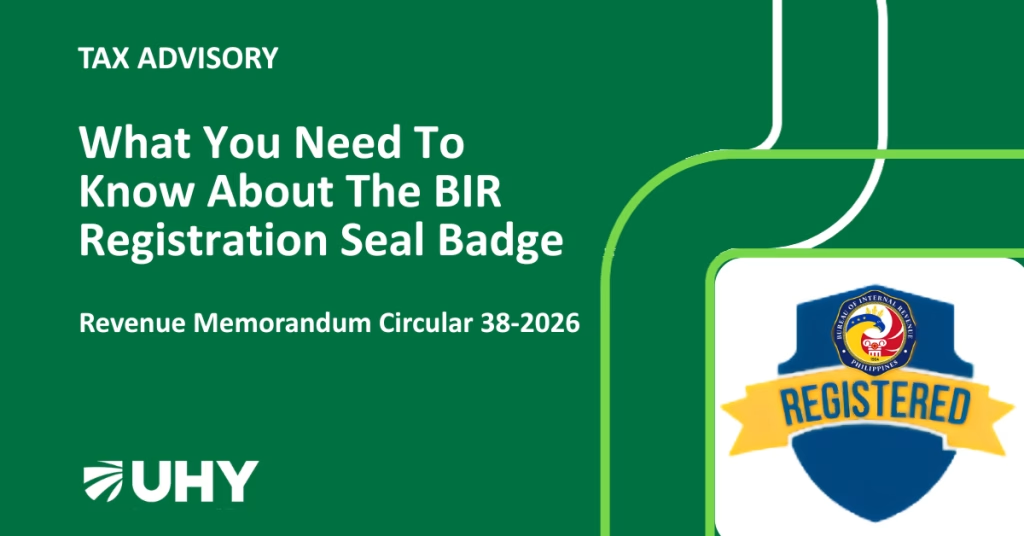
The Bureau of Internal Revenue (BIR) has issued Revenue Memorandum Circular (RMC) No. 38-2026, introducing new compliance requirements for businesses with an online presence. This advisory outlines the key provisions and implications for taxpayers engaged in e-commerce, digital services, and online content creation. Key Highlights of RMC No. 38-2026 Mandatory Posting of Proof of Registration […]
The Law in Numbers: Quantifying the Impact of Increased De Minimis Benefits

In the Philippines, the true measure of wealth lies not in gross income but in disposable income—the amount left after taxes and mandatory contributions. As one maxim reminds us, “A penny saved is worth two pennies earned, after taxes.” For compensation-income earners, statutory deductions such as withholding tax on compensation (WTC), Social Security System (SSS), […]
RMC No. 030-2026: Extension of Deadline for Filing of 2025 Annual Income Tax Returns
Filing for Income Tax Returns Is Extended Pursuant to Revenue Memorandum Circular (RMC) No. 030-2026, the Bureau of Internal Revenue has extended the deadline for the filing of the 2025 Annual Income Tax Returns (AITR), payment of the corresponding taxes due, and submission of required attachments from 15 April 2026 to 15 May 2026, without […]
RMC No. 24-2026: BIR Clarifies Tax Treatment of Cross-Border Services
The Bureau of Internal Revenue (BIR), through Revenue Memorandum Circular (RMC) No. 24-2026, provides much-needed clarification on the tax treatment of cross-border services following the issuance of RMC Nos. 5-2024 and 38-2024. These earlier issuances sparked significant discussion among taxpayers, particularly on whether services rendered offshore but benefiting Philippine entities could automatically trigger Philippine tax […]