What is the Electric Vehicle Industry Development Act?
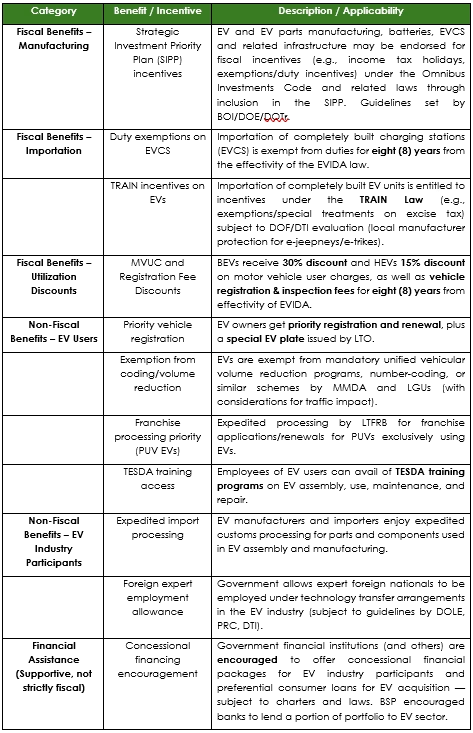
The Electric Vehicle Industry Development Act (EVIDA) establishes a comprehensive incentive framework to accelerate the growth of the electric vehicle (EV) industry in the Philippines. The law grants a mix of fiscal incentives—such as eligibility for investment promotion incentives, duty exemptions on EV charging infrastructure, and discounts on motor vehicle user charges and registration fees—as well as non-fiscal benefits, including exemption from number coding, priority registration, expedited franchise processing for EV public utility vehicles, and facilitative customs and regulatory measures. Collectively, these incentives reduce operational and capital costs, improve regulatory efficiency, and enhance market attractiveness for EV manufacturers, importers, infrastructure developers, and fleet operators. Businesses engaged in or planning to enter the EV sector should assess their eligibility for registration and incentive availment to strategically position their investments within the government’s priority industry roadmap.
Rules and Regulations of EVIDA
In the definition set forth in the Implementing Rules and Regulations (IRR) of the Republic Act (RA) No. 11697 or the EVIDA, an electric vehicle (EV) refers to a vehicle that has at least one electric drive used for propulsion. This includes battery electric vehicles (BEVs) powered solely by a traction battery; hybrid electric vehicles (HEVs) that combine a rechargeable energy storage system and a fueled power source; plug-in hybrid electric vehicles (PHEVs) that can be charged from an external electric energy source; and light electric vehicles (LEVs) used in micromobility, such as electric scooters and bicycles, typically weighing less than fifty kilograms (50 kg). Additionally, other vehicles may be recognized as EVs by the Department of Energy, provided they have at least one electric drive for propulsion.
Coverage:
Rule VII of the IRR of Republic Act No. 11697 (EVIDA) outlines the fiscal and non-fiscal incentives granted to promote the development of the electric vehicle (EV) industry, encourage EV adoption, and stimulate investments in EV manufacturing and charging infrastructure.
Key Takeaway
The incentives under the EVIDA signal a clear policy direction by the Philippine government to position the EV sector as a strategic and investment-priority industry. Through a combination of fiscal benefits—such as investment incentives, duty exemptions, and vehicle charge discounts—and non-fiscal support including regulatory facilitation, traffic privileges, and financing encouragement, the framework reduces entry barriers and improves the commercial viability of EV manufacturing, importation, infrastructure development, and fleet adoption. For investors, this creates a more predictable and cost-efficient operating environment while aligning with global sustainability trends.
The key question moving forward is how early movers can strategically structure their investments, registrations, and supply chains to fully leverage these incentives before competitive pressures and regulatory developments reshape the landscape.
Found this helpful? ♻️ Share and follow Babylon2K & UHY M.L. Aguirre & Co., CPAs for more.
P.S. Powered by hashtag#BethAI – ai.babylon2k.org, your intelligent assistant for tax, audit, accounting, and licensing.
Article written by: Kyle Clarence L. Williams, CPA, MICB, RCA, CAT ; Rhea Pelayo, CPA